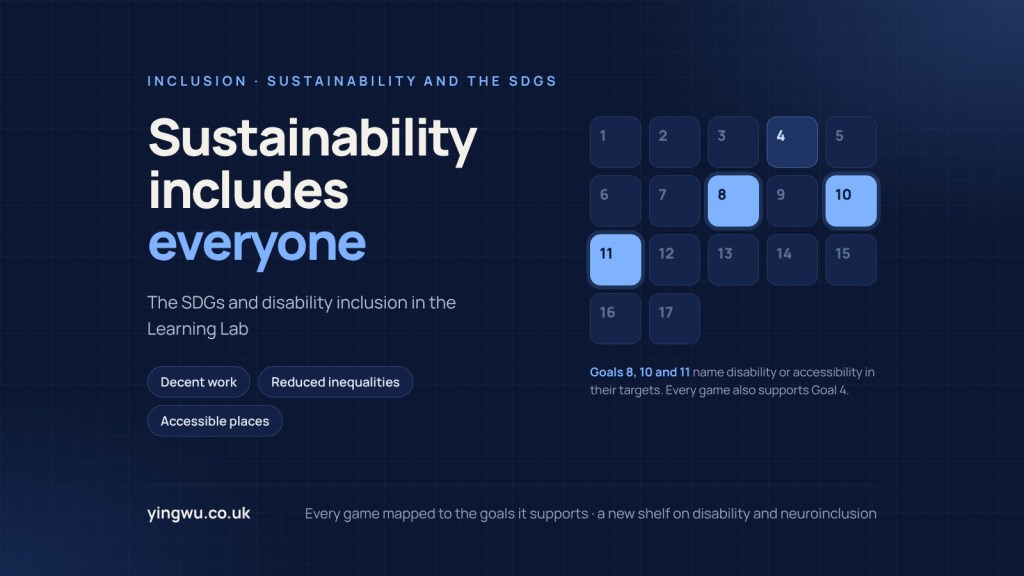
When people hear “sustainability” in a business school, they often think of carbon, packaging and supply chains. Those matter. But the UN Sustainable Development Goals set a wider test: whether growth is fair, whether work is decent, and whether places and services work for everyone. Disability is written into that test. So I have made two changes to the Learning Lab: every game is now mapped to the goals it supports, and there is a new shelf on disability, accessibility and neuroinclusion.
Every game now shows its goal
Games that cover a Sustainable Development Goal are now tagged with it, and each tag names the UN target it covers. You can browse the library by goal using the colour-coded goal tiles, or see every SDG game at once. Everything in the Lab also supports Goal 4, Quality education, through target 4.4: relevant skills for employment, decent jobs and entrepreneurship. Goal names and target wording come from the UN’s own SDG pages, so what learners see matches the official text.
I mapped the games to targets, not just to goals, for a simple reason. Claiming a goal is easy. Saying which target you are working towards, and how, is harder, and that is the habit I want learners to build.
Teaching the goals as decisions
Three games sit at the centre of this. In Goal Rush, learners first name each goal from its real UN targets, then match business moves to the goals they advance, and finally call each case: win-win, trade-off or SDG-washing. In Ripple Effect, they run a small Dundee fashion brand through six decisions, from cotton and shipping to energy, people and the brand’s big marketing claim. Every choice ripples across the 17 goals, the score weighs cash against impact, and some of the shortcuts come back to bite. Greenwash Detective asks learners to spot and fix misleading green claims before they reach customers.
With Bank the Unbanked and Campaign ER, they make up the Responsible business and the SDGs learning path, which works as a short sequence for a sustainability or responsible management module.
Where leadership comes in
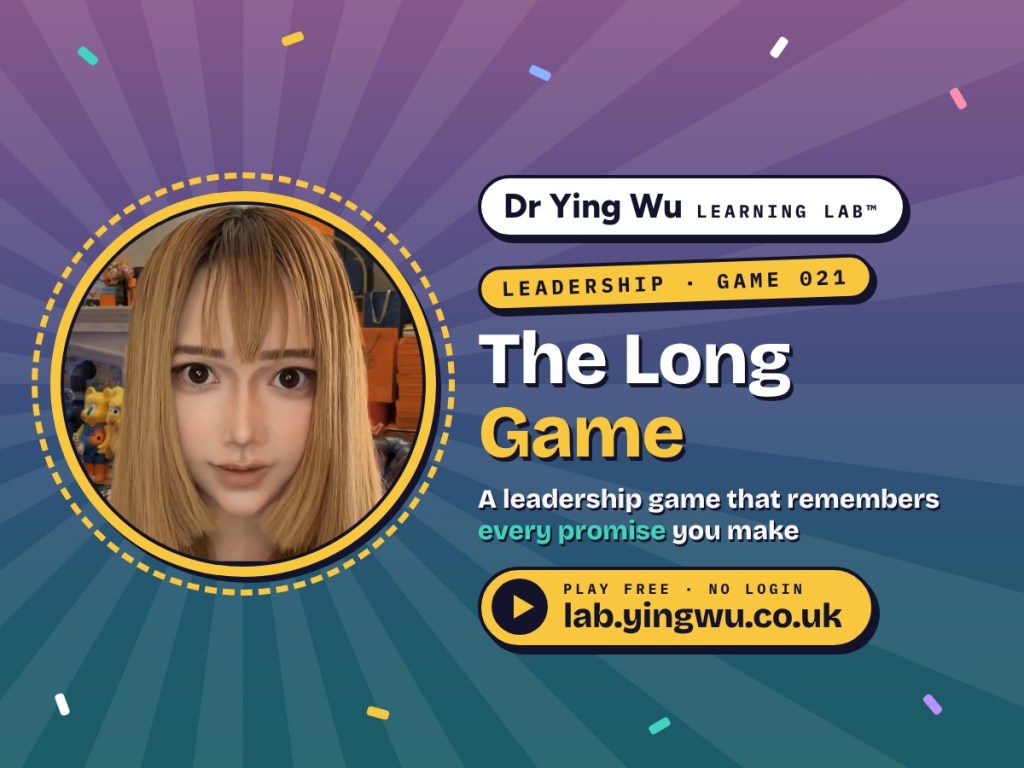
Teaching Globally Responsible Leadership for Sustainable Transformation with partner institutions across five countries keeps bringing me back to one idea: responsible leadership is less about big statements than about whether actions match them. SDG-washing is that gap at the level of an organisation, a goal on the website that the decisions do not support. The Long Game tests the same gap at the level of a person, by remembering every promise a leader makes and checking whether their choices match their values. I would pair them: Goal Rush and Ripple Effect for what an organisation claims and does, and The Long Game for what a leader says and does.
New: disability, accessibility and neuroinclusion
The goals name disability directly. Target 10.2 calls for the social, economic and political inclusion of everyone, including disabled people. Target 8.5 calls for decent work for all, including persons with disabilities, and target 11.7 for public spaces that are accessible to everyone. These are sustainability targets as much as any target on emissions. The new shelf is built around them, and its games are tagged with Goals 8, 10 and 11 where they apply.
- More Than Meets the Eye: judge twelve myths about non-visible and fluctuating conditions as true, false or “it depends”, then choose the right words in five everyday moments. Every answer links to its source.
- The Adjustments Desk: reply to eight fictional requests for support at work and at university, involving dyslexia, autism, fluctuating conditions and mental health. Pick the reply that is supportive and lawful, then see what the Equality Act 2010 and Acas guidance say.
- Open Doors: a simulation of neuroinclusive hiring. Redesign a small company’s job advert, selection day and first month within a seven-hour budget, then follow four fictional candidates through the process you built. It draws on Acas guidance and the Buckland Review of Autism Employment.
- Kerb Cut: walk through a shop front, a café and a community open day, spot the barriers and choose fair fixes. Then see the kerb-cut effect: a fix made for one group usually helps far more people.
- In Plain Sight: test colour contrast with a live meter, check designs through colour-vision filters and give a café notice a clear-print makeover, using WCAG 2.2 and guidance from GOV.UK, the Government Communication Service, RNIB and Sensory Trust.
They join two games that already had accessibility built in: Site Inspector, which includes colour-blind and screen-reader views of a website, and The Listening Room, which can be played with captions on or off. If you are not sure where to begin, the Disability inclusion starter path opens with More Than Meets the Eye.
How I built them
I wanted these games to be supportive and practical rather than a compliance quiz, and I wanted them to be right. The content was checked against UK law and official guidance in November 2026, and each game names its sources, including the Equality and Human Rights Commission, Acas, the Department for Transport, VisitScotland, RNID and the National Autistic Society. Every person and organisation in them is fictional, and they are general information, not legal advice. The games practise what they teach, with read aloud and adjustable settings built in.
They are also not only for students. Line managers, HR teams, small business owners, café owners, event organisers and community groups can play them in a few minutes, on their own or as a team.
Why this matters to me
This shelf grows out of several years of work on disability and digital inclusion: the Voicing Lived Experiences podcast on the real cost of living with disability in Scotland, Inclusive Futures, our conversations on inclusion with NUST Business School and sessions on digital accessibility in higher education. One lesson runs through all of it: many barriers are ordinary and fixable, and fixing them is part of running a responsible organisation, not an extra.
Use them
Like everything in the Learning Lab, these games are free, need no login and save nothing about you. Each one has a teacher’s guide for lecturers and trainers, and all of them are free to use and adapt for non-commercial purposes, with credit, under CC BY-NC-SA 4.0. If you use them, I would like to hear how it went and what to improve, through the feedback link on each game or my contact page.
References
- Buckland, R. (2024) The Buckland Review of Autism Employment: report and recommendations. London: Department for Work and Pensions. gov.uk
- Equality Act 2010, c. 15. legislation.gov.uk
- United Nations Department of Economic and Social Affairs (n.d.) The 17 Goals. sdgs.un.org/goals
- W3C (2024) Web Content Accessibility Guidelines (WCAG) 2.2. W3C Recommendation, 12 December 2024. w3.org/TR/WCAG22
Related reading on this site: