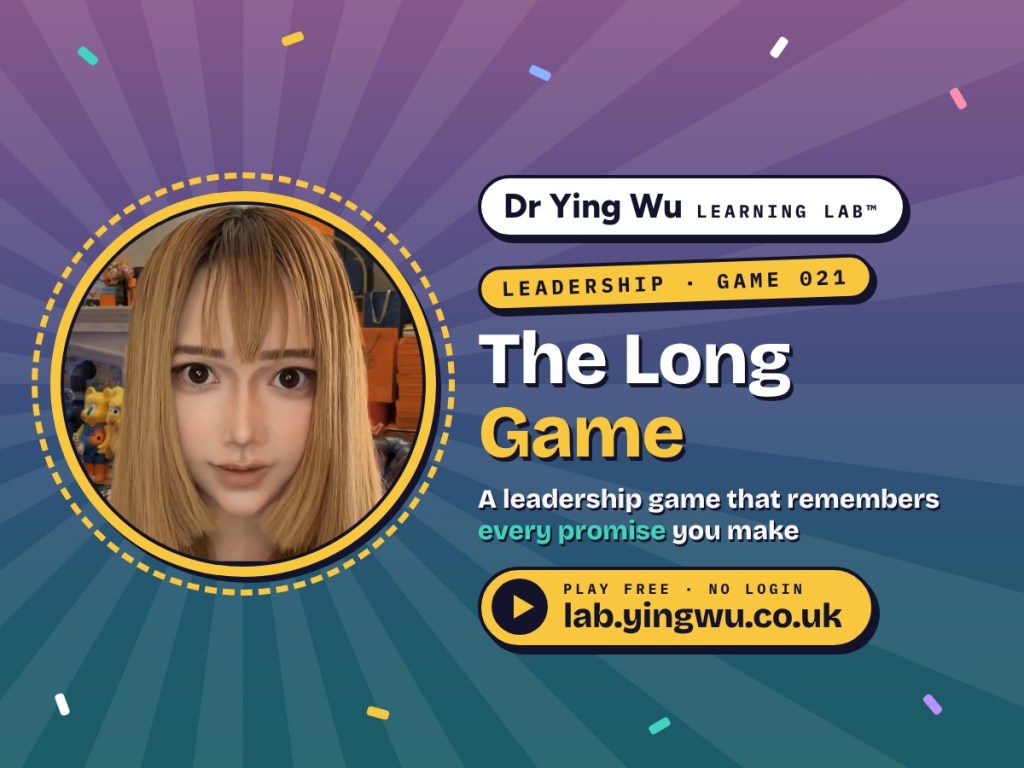
Nobody becomes a leader in other people’s eyes in one meeting. Teams make up their minds slowly, from small moments repeated week after week: whether you name the person who did the work, how you handle someone who doubts you, and whether the promise you made in week one is still standing when the busiest week of the term arrives. Speeches are easy. Consistency is the hard part, and it is hard to practise in a classroom. So I built a game for it.
How it works
In The Long Game, you choose three values you want to be known for, such as clarity, fairness or reliability. Then you lead a fictional team through a term, one situation a week: your first meeting, a colleague who laughs at the idea of you leading, a moment when a senior leader praises work someone else did, a split decision, a busy week, your own mistake, pressure from above. Each choice moves four meters that show how the team sees you: ability, care, integrity and visibility.
The twist is that the game remembers. Some choices make a promise in public, such as one-to-ones with everyone in the first month. That promise goes into a ledger and comes due weeks later, usually in the week when keeping it is hardest. Do you postpone with a friendly message, or keep the one-to-ones and make them shorter? A small promise kept in a busy week says more than any speech.
- Play a half term (6 weeks), a full term (11 weeks) or a full year (20 weeks). I added the full year because a player asked for a longer version.
- Choose how forgiving the team is: Supportive, Standard, or Tough crowd for a team that doubts you from day one.
- The debrief shows your say–do score (how often your choices matched your values), which promises you kept, how trust moved, and a habits plan you can copy.
- No login and nothing saved: everything is worked out on your own device and disappears when you close the page.
The thinking behind it
Three of the meters follow a well-known model of trust, in which we judge whether to trust someone on their ability, their benevolence (called care in the game) and their integrity (Mayer, Davis and Schoorman, 1995). The promise ledger and the say–do score draw on research into behavioural integrity: how closely people see a manager’s deeds matching their words (Simons, 2002). Visibility is my own addition for teaching, because being seen as the lead is not the same as being trusted. The meters are a mirror, not a mark: the team and the people are fictional, and the numbers are there to start a conversation, not to grade anyone.
For lecturers, trainers and coaches
The Long Game suits leadership and management modules, MBA programmes, new and aspiring manager development, graduate schemes and coaching. The teacher’s guide includes a 60 to 75 minute workshop: learners play a half term on their own, then play the full term as small leadership teams who must agree on shared values and name the value behind every choice. The learner guide has a pocket card of habits to take into real life, starting with a simple one: write down every promise you make this week, and keep all of them.
Like everything in the Learning Lab, it is free to use and adapt for non-commercial purposes, with credit, under CC BY-NC-SA 4.0. The citation is on the game page. If you use it with your learners, I would like to hear how it went and what to improve, through the feedback link on the game or my contact page.
References
- Mayer, R.C., Davis, J.H. and Schoorman, F.D. (1995) ‘An integrative model of organizational trust’, Academy of Management Review, 20(3), pp. 709–734. doi:10.5465/amr.1995.9508080335
- Simons, T. (2002) ‘Behavioral integrity: the perceived alignment between managers’ words and deeds as a research focus’, Organization Science, 13(1), pp. 18–35. doi:10.1287/orsc.13.1.18.543
Related reading on this site: