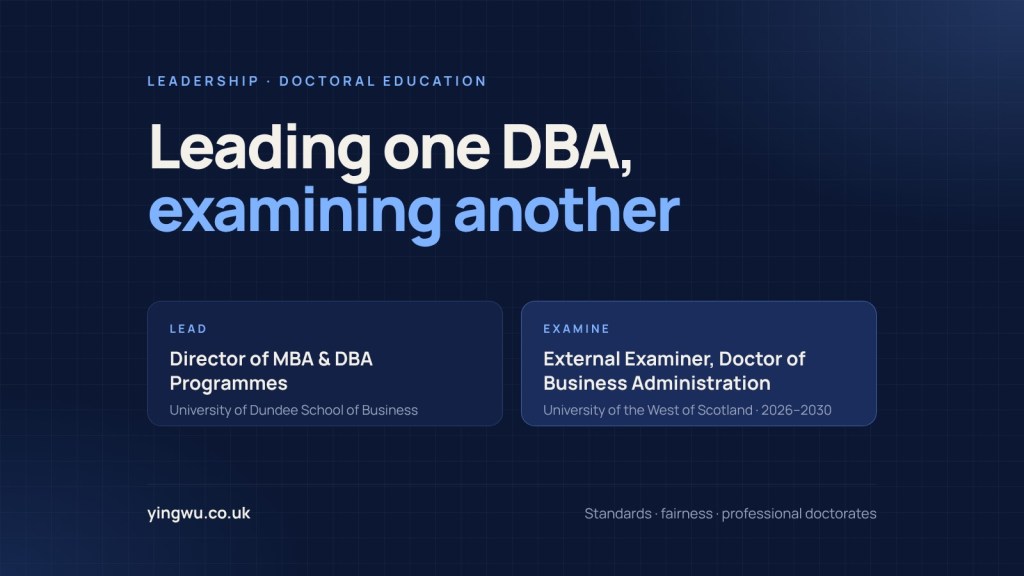
This autumn my role at Dundee widened. I am now Director of MBA & DBA Programmes, covering the Online MBA, the Global MBA (Advanced Entry) and the Doctor of Business Administration. In the same weeks, I began as External Examiner for the University of the West of Scotland’s DBA, delivered with Kings University College, a role that runs until 2030. Leading one doctoral programme while examining another is a useful pairing, and I want to set down why.
What an external examiner is for
In UK higher education, external examiners are academics from other institutions. They check that a programme’s standards are appropriate and comparable with similar programmes elsewhere, that assessment is fair and properly run, and they report on what is working well and what could be better. The role depends on independence. You are a critical friend, not a member of the team, and the value lies in seeing the programme from outside.
Why professional doctorates need this
A DBA is a doctorate for experienced practitioners. Its research has to be rigorous enough to stand beside a PhD and close enough to practice to change something in an organisation. Holding both at once is the hardest part of the programme, for candidates and for those of us who design and examine it. Most candidates also study part-time, alongside demanding jobs and often across countries and time zones, so the structure around them matters as much as the research itself.
What I bring to the role
Much of my recent work has been about standards and consistency across programmes. I coordinated our postgraduate Periodic Review, which re-approved the School of Business’s taught postgraduate provision to 2031/32. As School Assessment Lead for Management and Marketing, I audited postgraduate assessment across five subject areas, and the findings became a workload equivalence framework in School policy. As its inaugural Director, I led the launch of Dundee’s first Online MBA with more than twenty colleagues, for students across time zones. I have also supervised a PhD to completion and am now first supervisor to DBA candidates at Dundee.
The questions I will keep asking
These are the questions I will bring to examining, and the same ones I ask of our own DBA:
- Is each stage clear? Candidates, supervisors and examiners should share the same picture of what is expected at each milestone, from proposal to viva.
- Is assessment consistent? Across markers, across cohorts and against what comparable doctorates expect.
- Does the programme fit working lives? Part-time candidates need support that suits their schedules, not just the university calendar.
- Is the use of AI clear? Doctoral candidates need to know how generative AI may and may not be used in their work, and examiners need a fair way to judge it. I have written about this for the MBA in Teaching AI judgement in the MBA.
Learning in both directions
External examining is not one-way. Seeing how another institution and its partner run a DBA will sharpen how I lead ours, and I hope what I have learned at Dundee will be useful to colleagues there. External examining is also confidential, so I will not write about individual candidates or the details of the programme I examine. What I can share are the broader lessons about professional doctorates.
If you lead, supervise or examine professional doctorates and would like to compare notes, my contact page is open.
Related reading on this site: