When I first used the Learning Lab in class, it held two games and a toolkit I had built for my own modules. A few weeks on, it has grown into something much bigger than I planned, mostly because of the people who played the games and told me what they thought. This post rounds up what has changed, what people have said, and where you can follow along.
What people have been saying
The most useful feedback comes straight from the classroom. After each session I ask students what they liked and what I could improve, and I publish every answer exactly as typed on the Lab’s Student voice page.
“I need trophy.”
Search Marketing student, after Ad Auction Live
Request logged: winning teams now take one home. After Rank Rescue, my Search Marketing class gave the session five stars on Mentimeter and called it “fun and educative”. And after the very first run of SOSTAC® Sprint, which ended in a dead heat, another student said the games helped them remember the lecture notes.
The response on LinkedIn has been just as encouraging. When I shared SOSTAC® Sprint’s first classroom run, PR Smith, the creator of SOSTAC®, congratulated the class on an “innovative engaging edutainment game”. Professor Susan Kinnear called the Lab “an outstanding initiative”, and Dr Olanrewaju Lewis saw the potential for “a portfolio of pedagogic tools that could be adopted at scale”. A former Dundee students’ association vice-president even found that Bank the Unbanked echoed their own dissertation on fintech and financial inclusion.
Industry in the Lab
Industry partners have shaped the Lab as much as students have:
- NCR Atleos Biz-a-thon. Students played Bank the Unbanked before pitching to the judges. One undergraduate told me it helped because it was relevant to the topic and built on real-life examples, and that it fed straight into their project.
- Subject bites with industry. Jon Earnshaw of Pi Datametrics recorded a video especially for my Search Marketing class on what may be coming next for search. Students took his insight straight into Rank Rescue, and it now lives in the Lab as the first subject bite, on Google’s next spam update, with real ranking data and a “Spam or legit?” sorting task.
- Live Briefs. Small businesses and community organisations can now post real problems for students to take on. The first, from Campy Growers, is already being used in class, and more briefs are on the way.
New in the Lab
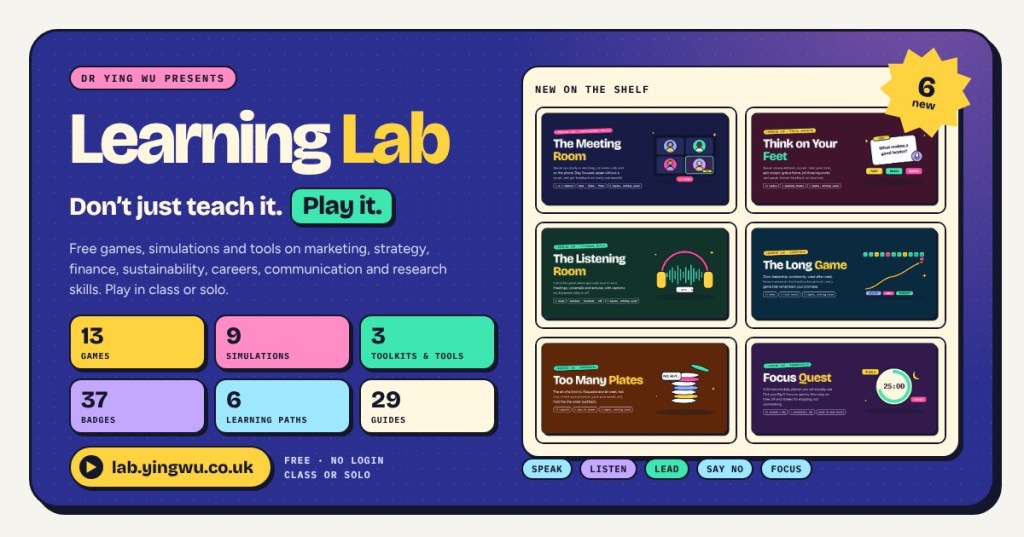
Browse by shelf. With more than 20 games and tools, the Lab needed a better way in. You can now pick a category, from Marketing & digital and Strategy & finance to Careers & employability, Communication & leadership, and Research & academic skills. Then narrow it down by format (live in class, self-paced, simulation or tool), by time (under 15 minutes up to longer projects) or by topic, or just press “Surprise me”.
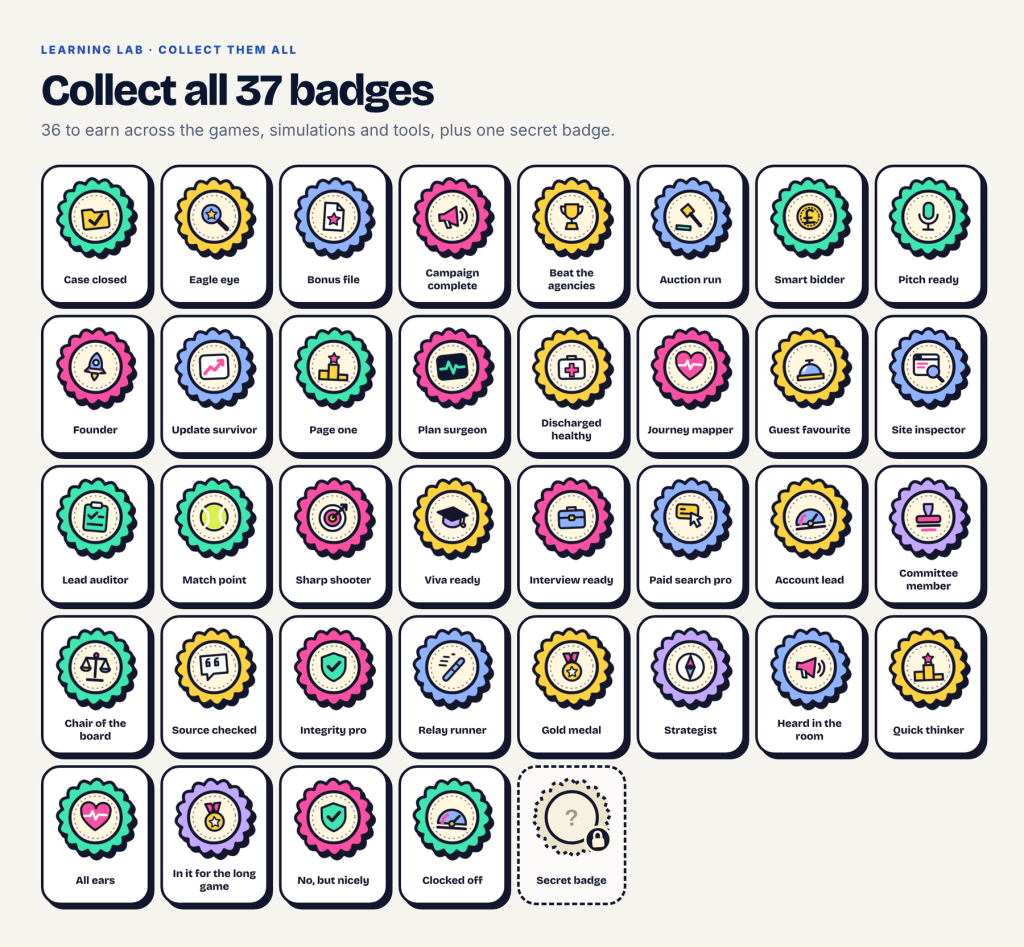
Learning paths. Short collections in a sensible order, like a mini course: a Marketing bootcamp, a Research student toolkit, Speak with confidence, Job-ready in a week and more. Ticks appear as you earn each game’s badge, and there are now 37 badges to collect.
Star ratings and feedback. Players can now rate a game when they finish it. I read every rating, share them whatever the score, keep comments exactly as typed and reply with what I’ll change. Lecturers who run a game with a class can also leave six-question feedback in about a minute, which shows me where the games make a real difference.
Play solo. Every game and simulation now works on your own phone or laptop as well as on the classroom screen, so students, graduates and professionals can play in their own time. Ad Auction Live and Bank the Unbanked both have new solo versions.
New games. The biggest additions are:
- Follow the Money, a three-episode mini-series on reading financial reports, for people who aren’t accountants.
- The Meeting Room, for speaking up clearly in meetings, on video and on the phone.
- Think on Your Feet, a speaking gym for when there’s no script.
- The Listening Room, for catching the point when you only hear it once.
- The Long Game, on showing leadership consistently, week after week.
- Too Many Plates, on saying no kindly and holding the line.
- Focus Quest, a 60-second daily planner that rewards stopping on time.
Each one comes with a learner guide and a teacher’s guide, so you can play it alone or run it as a workshop.
Now on MERLOT
The Lab’s games and toolkits are now listed on MERLOT, the international open educational resources library, which makes them easier for educators around the world to find and reuse. The Lab is shared under a Creative Commons licence (CC BY-NC-SA 4.0): anyone can use and adapt it for non-commercial teaching, as long as they credit the original.
Follow along
The Lab now has its own Instagram account, @learninglab.yingwu, where I share new games, quick challenges and what happens when they’re played in class. Everything is free, needs no login and collects no student data: explore the Learning Lab.
Outside my academic work, I’ve also built Worth it?, a set of free calculators for everyday trade-offs: what something really costs, whether it’s worth your time, which job really pays more and whether a greener switch pays off. Each answer prints as a receipt you can share. Try it at worthit.yingwu.co.uk or follow @worthit.yingwu on Instagram.
If you’ve used a game from the Lab, I’d love to hear how it went. And if you’d like a game built for your topic, get in touch through the Lab.
Some of this was first shared on LinkedIn. SOSTAC® is a registered trade mark of PR Smith; SOSTAC® Sprint is my independent, free teaching resource based on the SOSTAC® model.