Most conversations I have about AI in business education start with tools: which ones students may use, which ones we should teach, and how we know when they have been used. Those questions matter. The questions MBA graduates will face at work are different. Is this AI project worth funding? Who is accountable when it gets something wrong? How do we take a promising pilot into the way the organisation works every day?
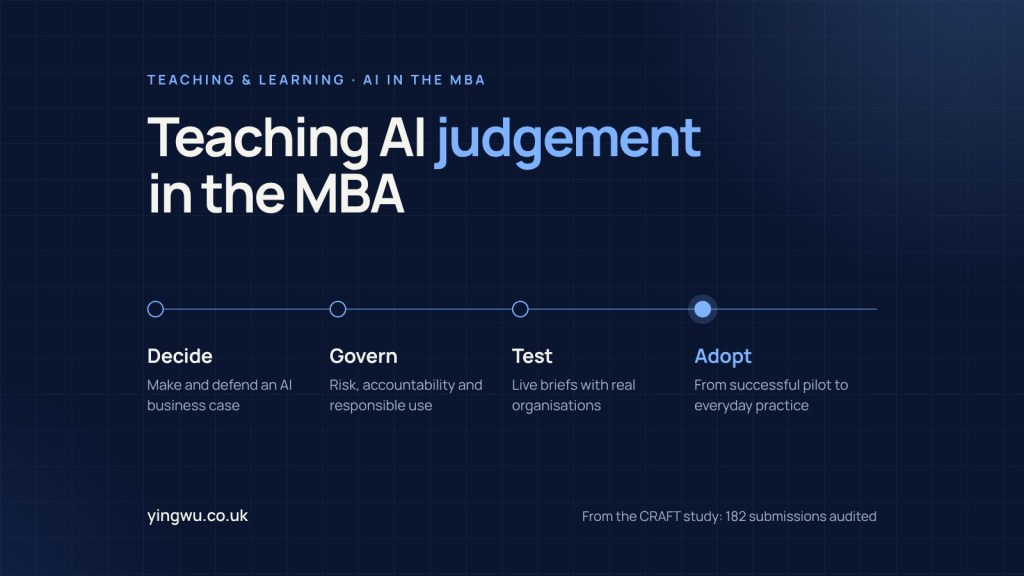
Those are questions of judgement, and my own research suggests we do not yet assess judgement well. In a study presented at the European Conference on Education 2026, Andrew Ross, Malcolm Stewart, Fahima Alam and I audited 182 student submissions across four assessment sets in which generative AI had been taught and demonstrated. None of the 182 showed students revising AI output or justifying it with disciplinary reasoning. Students had the tool. What the assessment had not done was ask them to show their thinking about it. That finding led to the CRAFT framework and the idea of specified latitude: saying where AI can be used, and what evidence of the student’s own judgement must stay visible and assessable.
The organisational side matters as much as the classroom. In a paper published this autumn in the Journal of Organizational Change Management, my co-authors and I looked at what shapes consumer attitudes to AI chatbots in fashion e-retail, and set out three pathways linking those responses to organisational change. The lesson for managers is that adopting AI changes how an organisation works, and the people affected by it, customers included, shape whether it succeeds.
This autumn I also sat the AWS Certified AI Business Strategist exam, partly to test my thinking against how industry frames these decisions. It is aimed at people who decide about AI rather than build it, and it covers evaluating AI investments, building a business case, governance and risk, and scaling adoption from pilot to production. That list is close to what I think an MBA should develop.
Putting these together, these are the principles I am bringing to programme development in the MBA and DBA portfolio I lead:
- Assess the decision, not only the output. Ask students to make and defend a case for or against an AI investment, with their reasoning, assumptions and trade-offs visible to the marker.
- Treat governance as a management skill. Risk, accountability and responsible use belong in strategy, operations and leadership teaching, not in a single ethics session.
- Test ideas against real organisations. Live briefs, of the kind set out in our BRIDGE framework, let students try a business case against an organisation’s actual constraints, capacity and data.
- Follow adoption past the pilot. Many AI projects stall between a successful trial and everyday use. That gap is a change management problem, and MBA students should practise working on it.
None of this needs students to become engineers. It needs them to ask good questions of the people who are, and to take responsibility for the answer.
If you lead a business programme or work on AI adoption and are thinking about the same questions, I would like to compare notes. You can reach me through my contact page.
Related reading on this site:
- BRIDGE and CRAFT: designing curriculum for industry and generative AI
- AI chatbots in fashion e-retail: from consumer responses to pathways for organisational change
- Learning Lab: free teaching games and toolkits
References
Wu, Y., Beaumont, K. and O’Riordan, R. (2026) ‘Industry-Integrated Curriculum Design for Employability in Marketing Education: The BRIDGE Process Framework’, The European Conference on Education 2026: Official Conference Proceedings. IAFOR. https://doi.org/10.22492/issn.2188-1162.2026.48
Wu, Y., Ross, A., Stewart, M. and Alam, F. (2026) ‘Designing AI-Supported Assessment in Marketing Education: Specified Latitude and the CRAFT Framework’, The European Conference on Education 2026: Official Conference Proceedings. IAFOR, pp. 637–658. https://doi.org/10.22492/issn.2188-1162.2026.49
Wu, Y., Stewart, M., Yamoah, F. A. and Alam, F. (2026) ‘AI Chatbot Integration in Fashion E-Retail: Consumer Behaviour Shifts and Pathways to Organizational Change’, Journal of Organizational Change Management. Published online October 2026. https://doi.org/10.1108/JOCM-03-2025-0295