Some good news from this autumn. A new postgraduate programme that I lead was approved at University scrutiny in October 2026. It brings the School of Business together with colleagues in a specialist science area ranked second in the UK in the Complete University Guide 2027. It is a faculty-level collaboration, and senior leaders across the Faculty have welcomed it as an important milestone.
What scrutiny involves
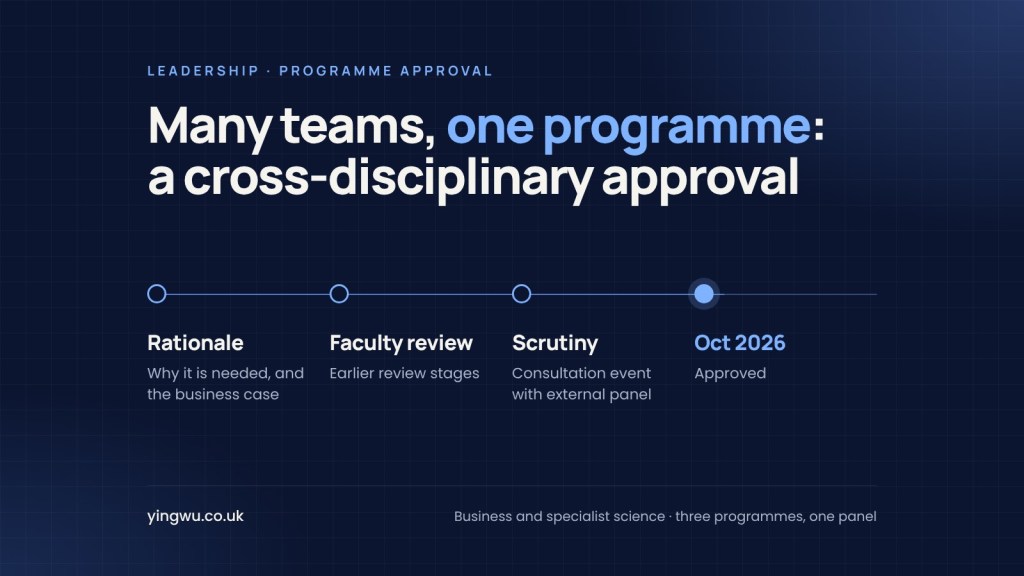
Before a new programme can recruit students, it goes through the University’s new programme development process, which has several stages. It starts with a programme rationale and business case, setting out why the programme is needed and how it will be sustained. The proposal then passes through earlier review stages within the Faculty before reaching a formal consultation event.
For that event, the team prepares a full documentation pack: programme specifications, module descriptors, an assessment strategy showing how each assessment maps to the intended learning outcomes at the right academic level, and an overview of the staffing and expertise behind the programme. This programme was considered alongside two others at the same event, so all three packs had to be ready on one timeline. The panel, which includes external members, then tests the case in person: whether the programme is coherent, whether the academic standards are right, and whether students will be well supported.
It is a demanding process, and a useful one, because it asks the team to explain every design decision.
Many teams, one programme
Cross-disciplinary programmes ask more of everyone involved. Business educators and subject specialists bring different conventions: how learning outcomes are phrased, what counts as good evidence in an assessment, and how professional standards shape a curriculum. Agreeing a shared language early made the rest of the work easier.
The programme also depended on colleagues beyond the academic team, including those who support quality assurance, programme approval and recruitment. Bringing several teams to the same deadline, with one coherent set of documents, was as much a part of the work as the curriculum itself.
My role
Programme lead, from design to scrutiny
As programme lead, I brought the business and management perspective to the programme across many cross-disciplinary meetings with subject-specialist colleagues, from early design through to approval.
- Programme design: co-designed the programme with subject-specialist colleagues, including how the management elements fit alongside the specialist content.
- Documentation: drafted the programme specification and early web content, and revised the programme documents through successive drafts ahead of scrutiny.
- Assessment: mapped the assessments to the programme learning outcomes.
- Inclusive design: reviewed the specialist module specifications with a focus on accessibility and inclusion.
- Scrutiny: represented the School of Business in the team that presented the programmes to the panel, whose positive response to the collaboration was good to hear.
Special thanks go to the senior and widely respected colleague I worked with most closely, a Professor of Practice whose international career in professional practice brought practitioner insight and real-world authority to the programme. It has been a pleasure working together, and our partnership shows what business education and specialist science can achieve side by side.
Thank you to everyone involved. More to share when the programme opens for applications.
Programmes and leadership
More on the programmes I lead and contribute to.