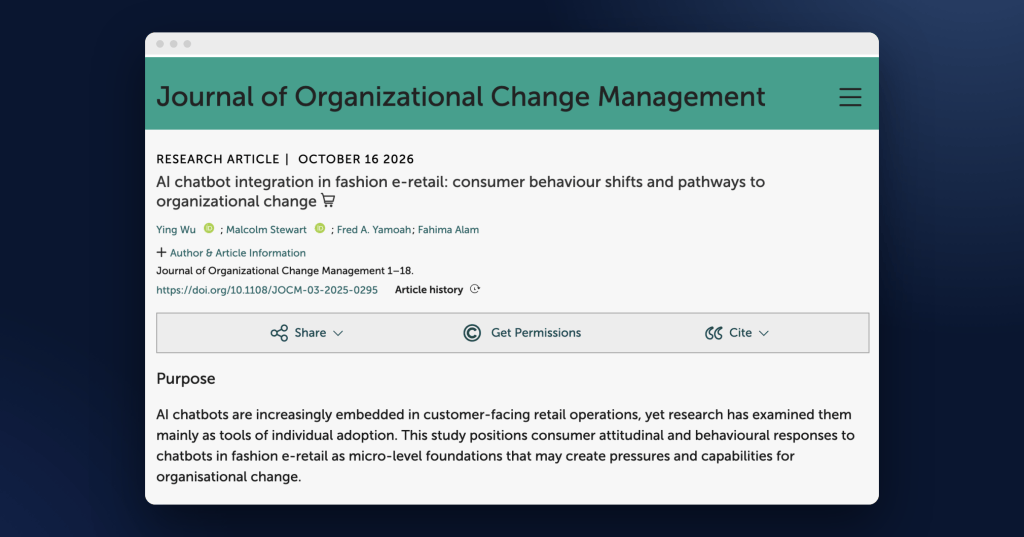
Most research on AI chatbots in retail asks a familiar question: will consumers use them? Our new paper in the Journal of Organizational Change Management starts there, but then asks what comes next: what might consumer responses to chatbots mean for the organisations that deploy them?
I’m delighted to share it, written with Dr Malcolm Stewart, Prof. Fred A. Yamoah and Dr Fahima Alam.
What we studied
We surveyed 776 UK consumers about AI chatbots in fashion e-retail. Our model brings together several established perspectives on technology use, including the technology acceptance model, the theories of reasoned action and planned behaviour, and uses and gratifications theory. We then tested how technology readiness, perceived adaptiveness, enjoyment, social value and the views of others relate to consumers’ attitudes and intentions.
What we found
Two factors stood out. Hedonic motivation (whether using the chatbot feels enjoyable) and perceived adaptiveness (whether it responds to the individual shopper) were the strongest influences on attitudes. Attitude, in turn, strongly predicted whether people intended to use chatbots. Perceived usefulness mattered too, but it worked through attitude, and consumers’ technology readiness mattered mainly through how adaptive they found the chatbot.
That fits fashion well. Buying clothes is about identity and experience as much as efficiency, so a chatbot that simply answers questions quickly may not be enough.
From consumer responses to organisational change
The paper then goes a step further. Treating these consumer responses as micro-foundations, we theorise three pathways through which chatbot integration may contribute to organisational change:
- Shifting customer expectations. As shoppers come to expect enjoyable, adaptive interactions, those expectations put pressure on how services are designed.
- Data-enabled organisational learning. Chatbot conversations create a stream of customer insight that organisations can learn from.
- Reconfiguring service work. As chatbots take on more customer contact, roles and emotional labour are redistributed between people and technology.
These are theorised pathways rather than observed change. Our data are cross-sectional and come from consumers, so testing the pathways over time and across industries is an important next step.
What it means in practice
For managers, the message is to treat chatbots as part of the customer experience rather than only a cost-saving tool, to rethink service measures so they capture enjoyment and adaptiveness, and to plan for the effects on people’s roles. The paper also raises wider concerns, including digital exclusion and deskilling, and makes the case for accessible, human-centred chatbot design that still leaves room for human interaction where it matters.
The study connects with my wider work on AI in consumer behaviour and in business education, including the CRAFT framework for AI-supported assessment.
Read the article:
- Wu, Y., Stewart, M., Yamoah, F. A. & Alam, F. (2026). AI chatbot integration in fashion e-retail: consumer behaviour shifts and pathways to organizational change. Journal of Organizational Change Management, 1–18. https://doi.org/10.1108/JOCM-03-2025-0295
Originally shared on LinkedIn.